


Minister credits investigative journalism as forensic report exposes R836m tender
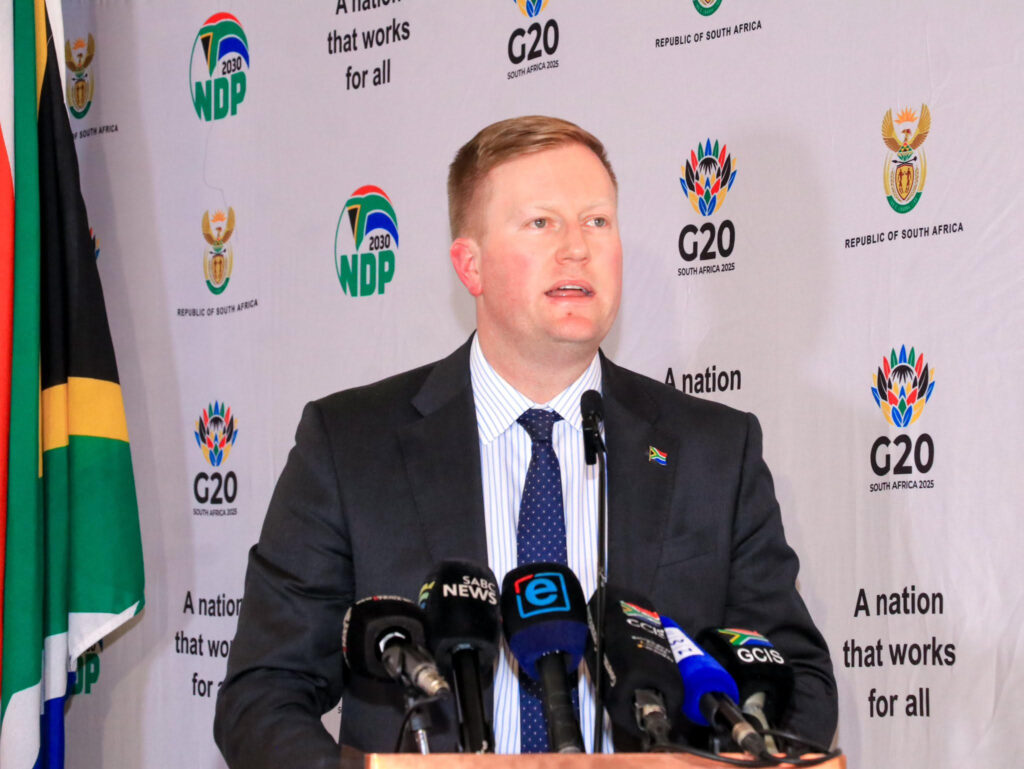
Minister of Public Works and Infrastructure Dean Macpherson at the G20 summit 2025
image: Dean Macpherson on X
by Mathipa Phishego
Dean Macpherson, Minister of Public Works and Infrastructure, announced a forensic study on Tuesday that verified numerous irregularities in the Independent Development Trust’s (IDT) awarding of a R836-million oxygen plant tender. Pieter-Louis Myburgh, a journalist, first revealed the findings of a months-long inquiry in December of last year.
According to information obtained by InsideOutNews, Myburgh and Azarrah Karrim of amaBhungane were able to link over half of the R428 million contract to what seems to be a non-existent business. Their reporting brought up significant issues regarding the fairness of the bidding procedure, which finally resulted in the contract being cancelled and the forensic results on Tuesday.
Minister Macpherson praised the media’s role in a news briefing that coincided with the report’s release, saying, “I firstly want to pay tribute to the media who first blew the whistle on this matter.” South Africa benefits from investigative journalism, which makes public officials and those working for our government agencies responsible for their actions.
The findings were Companies awarded contracts without valid SAHPRA licences, a R216m budget ballooned to R592m without justification, bulkeng awarded R428m despite only qualifying for R200m, minutes missing and no recordings of adjudicating committees, processes bypassed, red flags ignored. And disciplinary action recommended against senior officials. “We are taking swift, decisive action to ensure accountability and clean up public procurement for good,” stated the minister at a press briefing.
Macpherson’s remarks were an unusual and candid admission by a high-ranking government official that this multimillion-rand affair might have gone unreported in the absence of investigative journalists. The Department of Public Works commissioned the forensic analysis, which suggested that Tebogo Malaka, the CEO of IDT, and a number of other executives face disciplinary action.
It also brought to light egregious governance shortcomings, which led to the board’s dissolution and the start of reforms at the troubled organisation. Hundreds of millions of taxpayer dollars would have probably been wasted if the exposé had not been made public. For many years, the IDT, a government implementing agency charged with carrying out infrastructure projects, has been accused of poor administration and monitoring.
These worries are strengthened by the most recent scandal. The core problem still exists, but the minister has promised to take action on the report’s recommendations for the time being. Perhaps long-standing networks of patronage within governmental institutions can be eliminated through structural change.
This inquiry is a prime example of the press’s watchdog function, which holds authorities accountable via the perseverance of reporters who refuse to allow corruption to go unchecked.